


Personal, Social and Health Education & Relationship and Sex Education (PSHE & RSE)
The PSHE policy was reviewed and updated in June 2026 to ensure it is in line with the latest government requirements and guidance for PSHE. Parents were consulted as part of this process, and the updated policy can be found below.
What is PSHE Education?
PSHE Education (Personal, Social, Health and Economic Education) is a planned programme of learning through which children and young people acquire the knowledge, understanding and skills they need to successfully manage their lives – now and in the future. As part of a whole-school approach, PSHE Education develops the qualities and attributes pupils need to thrive as individuals, family members and members of society.
What do schools have to teach in PSHE Education?
According to the National Curriculum, every school needs to have a broad and balanced curriculum that:
• promotes the spiritual, moral, social, cultural, mental and physical development of pupils at the school;
• prepares pupils at the school for the opportunities, responsibilities and experiences of later life;
• promotes British values.
Schools also have statutory responsibilities to safeguard their pupils (Keeping Children Safe in Education, DfE 2023 and to uphold the Equality Act (2010).
The Jigsaw Programme supports all.
What is Jigsaw, the mindful approach to PSHE, and how does it work?
Jigsaw is a whole-school approach and embodies a positive philosophy and creative teaching and learning activities to nurture children’s development as compassionate and well-rounded human beings as well as building their capacity to learn.
Jigsaw is a comprehensive and completely original PSHE Education programme (lesson plans and teaching resources) for the whole primary school from ages 3-11 (12 in Scotland). Written by teachers and grounded in sound psychology, it also includes all the statutory requirements for Relationships and Health Education, and Sex Education is also included in the Changing Me Puzzle (unit).
Jigsaw has two main aims for all children:
• To build their capacity for learning
• To equip them for life
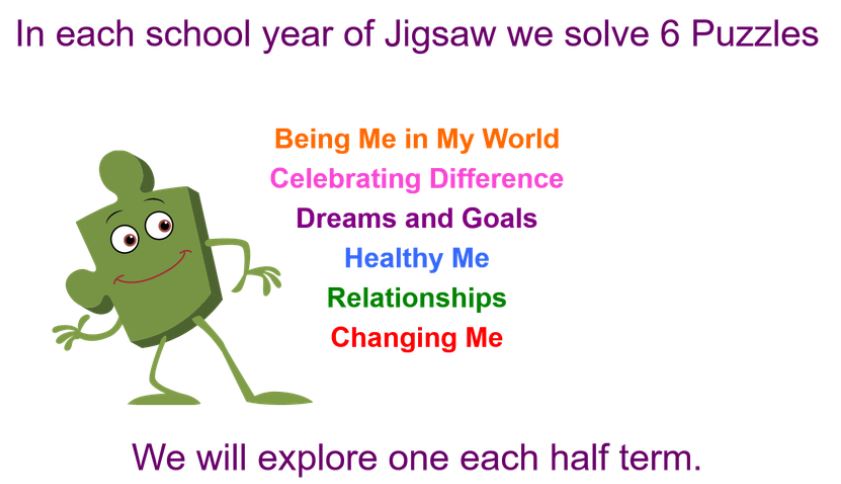
Click for individual year group knowledge organisers outlining the knowledge, skills and vocabulary for each puzzle in each half term.
SUMMER 1 FOCUS
 This half term in PSHE & RSE, our focus is Relationships. Children will learn how to build positive relationships with family, friends and others. They will develop an understanding of their own feelings and those of others, explore what makes a healthy relationship, and learn about kindness, respect and personal boundaries. There will also be a focus on knowing how to ask for help and how to stay safe, including online.
In Reception children will explore their place within their family and school, learn how to make friends, understand the impact of kind and unkind words, and begin to manage their feelings and solve simple friendship problems.
In Year 1, pupils will develop their understanding of different families and friendships, learn what it means to be a good friend, recognise their own positive qualities, and know who can help them in school.
In Year 2, children will build on this by exploring cooperation, managing conflict in friendships, understanding safe and unsafe secrets, and recognising the importance of seeking help and valuing special relationships. 
Further Information about Jigsaw for Parents:
How LGBTQ content is taught in Jigsaw: A Parent Guide